


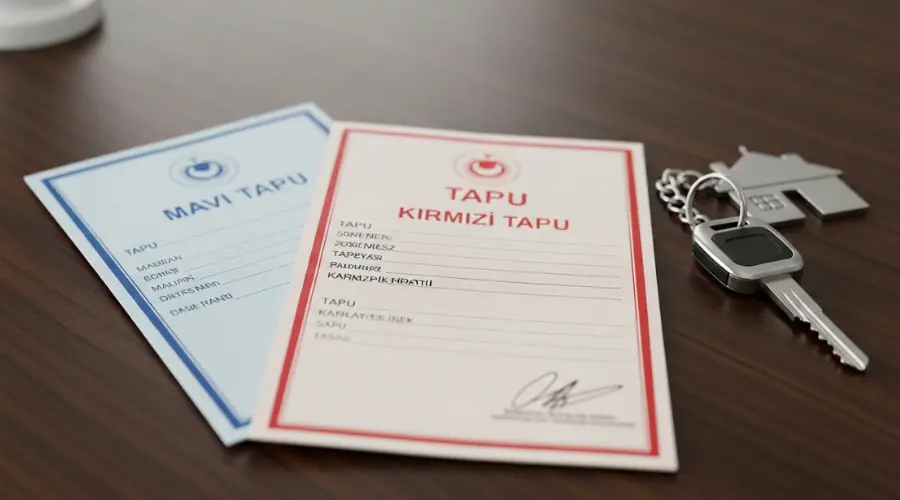
Buying property in Turkey can be one of the most profitable investments of your life, or conversely, it can turn into a financial nightmare. The line between these two fates often lies in the color of a single piece of paper: the Tapu (Title Deed). Many international investors planning to buy property in Istanbul or other Turkish cities encounter terms like "Blue Tapu" and "Red Tapu" at the very first step. But did you know that buying a luxury villa with a Blue Deed could mean purchasing illegal agricultural land facing the risk of demolition at any moment?
In this comprehensive article, using the latest regulations of 2026, we reveal all the secrets behind the colors of real estate deeds in Turkey so you can invest with your eyes open.
1. What is a Tapu and Why Does Its Color Matter?
In Turkey, the land registry system differs fundamentally from many other countries. Unlike some jurisdictions where handwritten contracts or notarized agreements hold high validity, only one institution has absolute power in Turkey: The General Directorate of Land Registry and Cadastre (Tapu ve Kadastro).
The Tapu is the only official and legal document proving your ownership of a property. A crucial point is that in Turkey, any sale or purchase agreement made in real estate offices or even at a Notary Public (Noter) does not grant you absolute ownership (Real Right) until it is registered in the centralized Cadastre and Tapu system. Those contracts are merely personal obligations, but a Tapu signifies absolute ownership.
Why is the Deed Color (Blue or Red) Vital?
The border color of the Tapu is not just a graphic design; it indicates the legal nature of the property. The color tells you whether you are buying "land" or an "independent building/unit."
-
Blue Tapu: Means you own the land (Plot/Field).
-
Red Tapu: Means you own an independent unit (Apartment, Shop, Villa), including the building and a share of the land.
Ignoring this difference could lead you to pay for an apartment but legally own only a piece of barren land!
2. What is a Blue Tapu (Mavi Tapu)?
The Blue Tapu (Mavi Tapu) represents the most basic form of ownership. When the border of your deed is blue, the subject of ownership is "land." Even if there is a building on that land, legally, that building is either not yet recognized or does not officially exist.
Blue Deeds are divided into two critical categories, and confusing them is the most dangerous investment risk. In Blue Deeds, the section labeled "Niteliği" (Nature of Property) must be read carefully.
Types of Blue Deeds
1. Agricultural Land (Tarla)
If the word Tarla appears in the "Nature" section, you are dealing with a field or agricultural land.
-
Features: These lands are usually large, and their soil is protected as a national resource.
-
Construction Permit: In 99% of cases, construction on a "Tarla" is forbidden. Only in very specific conditions and for very large plots (usually over 5,000 square meters) might a permit for a small farm worker's house be granted.
-
Major Risk: Many scammers subdivide cheap agricultural land and sell it to foreigners as "villa plots."
2. Zoned Land for Construction (Arsa)
If the Blue Deed states Arsa, it means the land is within urban boundaries, the municipality has deducted the share for public services (like roads and parks), and construction permits have been granted.
-
Value: The price of "Arsa" is much higher than "Tarla" because it holds construction potential.
-
Usage: This deed is perfect for developers or individuals wanting to build their own private villa.
Restrictions for Foreign Nationals on Blue Deeds
One of the vital points emphasized in the 2025 and 2026 regulations is the "2-Year Project Rule."
If you, as a foreign national, buy land (whether agricultural or residential) that has no building on it (i.e., a Blue Tapu), you are legally obligated to submit a project (such as a home construction or agricultural plan) to the relevant ministry within 2 years and commence execution.
If you fail to do so, the state has the right to reclaim the property from you and auction it off! This is a risk many land buyers are unaware of.

3. What is a Red Tapu (Pembe/Kırmızı Tapu)?
The Red Tapu or Pink Tapu is a symbol of security and completion. This deed is issued when the legal subdivision process is complete, and a separate deed has been created for each unit (Apartment, Shop, Office).
A Red Tapu indicates that you own not just the land, but also an "Independent Unit" (Bağımsız Bölüm). However, the Red Tapu has two phases, and the difference between them is crucial regarding price and transaction security.
Key Sections of the Red Deed
In the middle of the Red Deed, there are three options. The one that is checked indicates the legal status:
1. Kat İrtifakı (Construction Servitude)
This phase can be called the "Pre-sale Deed" or "Floor Easement."
-
When is it issued? When the developer obtains the building permit and starts the project, they split the main land deed and obtain a "Kat İrtifakı" deed for each unit.
-
Legal Meaning: This deed states that you own a share of the land, which corresponds to unit Y on floor X once built.
-
Risk: If the building is abandoned halfway or built against regulations (e.g., adding an illegal floor), your deed remains in this phase and does not convert to full ownership. Many old buildings in Turkey remain in this stage due to zoning violations.
2. Kat Mülkiyeti (Full Ownership / Condominium)
This is the "Gold Standard" of Turkish real estate. If you are looking for a Kat Mülkiyeti deed, you are looking for the most flawless type of ownership.
-
When is it issued? After construction is finished and the developer obtains the "Iskan" (Habitation Certificate) from the municipality, the deeds convert to Kat Mülkiyeti.
-
Security: This checkmark on the deed means the building was built according to the plan, is earthquake-resistant, has no debts to the municipality, and is completely legal. Banks prefer this type of deed.
4. Comparison Table: Key Differences at a Glance
To help you decide faster, we have summarized the differences between these two deeds in the table below:
| Feature | Blue Tapu (Mavi) | Red Tapu (Kırmızı) |
| Subject of Ownership | Land (Plot/Field) | Independent Unit (Home/Shop) |
| Building Status | Non-existent or Illegal | Under construction or Completed |
| Usage | Agriculture (Tarla) or Construction (Arsa) | Residential, Commercial, Office |
| Residency Permit | No (Except in very specific cases) | Yes (If value exceeds $200,000) |
| Citizenship Application | Yes (High valuation risk) | Yes (Safest method) |
| Bank Loan | Very difficult and low amount | Available (On Kat Mülkiyeti deeds) |
| Utilities (Water/Electricity) | Expensive rates or impossible | Normal rates and legal |
| Investment Risk | High (Requires expertise) | Low to Medium |
Warning (Callout):
Never pay the full price for an apartment that still has a Blue Deed!
If a seller shows you an apartment but the deed is still Blue, it means the building has not been legally subdivided and lacks a habitation certificate (Iskan). In this case, you legally are buying only a share of shared land, not that specific apartment. This is one of the biggest real estate traps in Turkey.
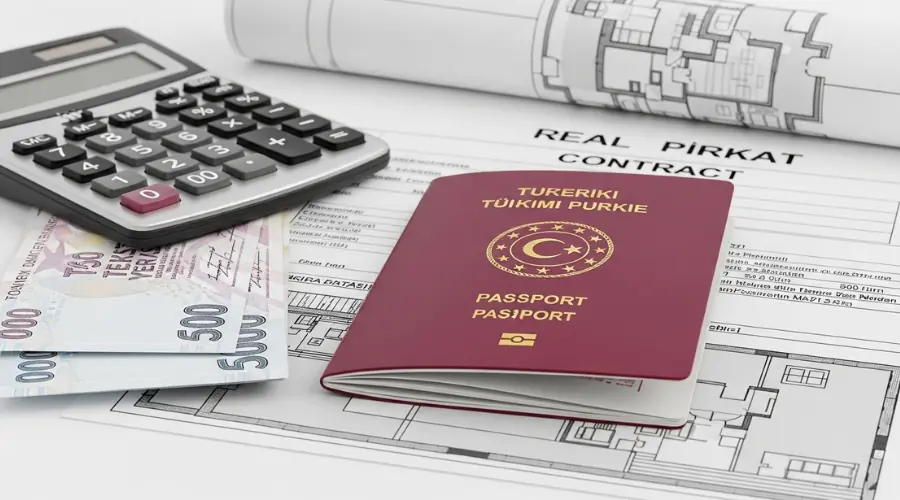
5. Which Deed is Suitable for Turkish Citizenship or Residency?
This question has changed the fate of many immigrants. Turkey's immigration laws underwent significant changes in 2024 and 2025.
Crucial Point: Can You Get Residency with a Blue Tapu?
Short answer: No.
According to new Immigration Authority regulations, to obtain real estate residency (Ikamet), the purchased property must be designated as "Mesken" (Residential) and be habitable. A Blue Tapu means land, and you cannot reside on land. Therefore, if your goal is to get a residence permit to live in Turkey, cross the Blue Tapu off your list.
For residency, you need a property with a Red Tapu where the appraisal value at the time of purchase exceeds $200,000.
The Role of Red Tapu in $400,000 Citizenship Cases
To obtain a Turkish Passport (via a $400,000 investment), both types of deeds (Blue and Red) are theoretically acceptable. However, there is a major challenge:
-
The Blue Tapu Problem in Citizenship: Usually, the official government value of land in Turkey is much lower than the actual market price. For example, you might buy land for $500,000, but the official expert (Ekspertiz) might value it at $200,000. In this case, your citizenship application will be rejected.
-
The Red Tapu Advantage: Newly built apartments with Red Deeds usually have appraisal values closer to the sales price, posing less risk for the citizenship process.
6. Legal and Safety Tips Before Signing
Before entering the signing room at the Tapu office, you must pass the following checklist. Otherwise, your capital is at risk.
1. Municipality and Tapu Inquiry
Never rely solely on the real estate agent's word. You or your lawyer must visit the local municipality in the relevant district and check the Zoning Plan.
-
Is this land in a green space project?
-
Is there a demolition order for the building?
-
Has a Habitation Certificate (Iskan) been issued for this apartment?
2. Check for Liens or Mortgages (İpotek)
Verify that the deed is "clean." A property with a heavy bank mortgage (İpotek), court seizure (Haciz), or usufruct right held by someone else cannot be fully transferred, or its debts will transfer to you. This information can be seen in the "Takyidat" document.
3. The "Blue Deed Villa" Trap
Take this seriously! You often see a stylish villa, but the seller gives you a Blue Tapu designated as "Garden" (Bahçe) or "Field" (Tarla).
This means that the villa does not exist in the eyes of the Turkish state and is an illegal construction on agricultural land.
-
Danger: The municipality can issue a demolition order.
-
Penalty: You cannot get legal water and electricity subscriptions, and earthquake insurance (DASK) will not pay you in case of a disaster.
4. Comparing Stated vs. Actual Square Footage
In Turkish deeds, there are two types of area: "Net" and "Gross" (Brüt). Sometimes advertisements state the Gross area (including common areas, parking, and walls), which is much larger than the actual living space. Always ask for the "Net" area.
FAQ About Title Deeds in Turkey
In this section, we answer the most frequently asked questions by internet users regarding deed differences.
Can a Blue Tapu be converted to a Red one?
Yes, but it is a costly and time-consuming process. If you have land (Blue Tapu) and build a legal structure on it, you must invite municipality inspectors upon completion. If the building is in accordance with the plan and regulations, they will issue an "Iskan," and then you can change the property type (Cins Tashihi) at the Tapu office to obtain a Red Tapu.
How much is the Title Deed Transfer Fee (Tapu Harcı)?
In 2026, the title deed transfer fee is 4% of the property value. Legally, this amount should be split 50-50 between buyer and seller, but according to Turkish market custom, the buyer usually pays the full 4%. Additionally, a "Revolving Fund" (Döner Sermaye) fee, which increased in 2026, must be paid.
Is a Blue Tapu good for medium-term investment?
Blue Tapu (especially "Arsa" in developing regions) has very high profit potential, but the risk is also high. This type of investment is suitable for those who:
1. Have a long-term vision.
2. Are familiar with zoning and construction laws.
3. Do not intend to obtain immediate residency.
However, if you are cautious and investing your life savings, a Red Tapu (ready-to-move apartment) is a safer option.
Final Word
In the bustling Turkish real estate market, knowledge is power. The difference between a Blue and Red Tapu is not just a color; it is the difference in usage, legal security, and the future of your capital. When buying property, always seek assistance from experienced lawyers and reputable consultants, and never pay without making an inquiry at the Land Registry/Cadastre Directorate.