



Buying property in Turkey has been one of the most attractive yet challenging methods of immigration and investment for foreign investors. With extensive changes made to the laws of the Turkish Presidency of Migration Management, many applicants have faced significant ambiguities. The days of obtaining residency by purchasing a cheap property on the outskirts of cities are over. Below, with a close look at the latest legal updates of 2025, we have compiled everything you need to know about the $200,000 rule, vital details of the Title Deed (Tapu), and the differences between residency and citizenship in simple language.
The New $200,000 Property Purchase Rule in Turkey
In recent years, the Turkish government faced a massive wave of demand for property purchases, which led to an excessive increase in housing prices for its own citizens. To control this situation and ensure the attraction of genuine investors, the Presidency of Migration Management changed the rules from "lenient" to "selective."
As of October 16, 2023, the minimum amount for obtaining real estate residency (known as Taşınmaz residency) was increased to 200,000 USD. The purpose of this figure is to filter out buyers who intended to occupy residential capacities with insignificant amounts. In 2025, this law has stabilized, and there are no exceptions for small or large cities.
Difference Between the Old Law ($75k) and the New Law
In the past, Turkey had two different rates based on the population of cities:
- Under the Old Law: For large cities like Istanbul, Ankara, Antalya, and Izmir, the amount was $75,000, and for smaller cities, it was $50,000.
- Under the New Law: The distinction between small and large cities has been removed. Now, anywhere in Turkey, from the heart of Istanbul to the most remote villages of Van or Trabzon, you must invest at least $200,000 to be eligible for a residence permit.
Is the Appraisal Value (Ekspertiz) the Criterion or the Amount on the Deed?
Many sellers in Turkey state a lower transaction amount on the deed to evade taxes. Under the new law, the criterion for the Presidency of Migration Management to grant residency is solely the amount stated on the Title Deed (Tapu).
- Appraisal Report (Ekspertiz): This report is prepared by government-approved companies and estimates the real value of the property. Having this document is mandatory for all foreigners.
- The Number on the Deed: The figure registered at the Land Registry Office must be equivalent to or higher than $200,000 based on the exchange rate on the day of the transaction.
Note: If your appraisal report is $300,000 but the amount stated on the deed is $150,000 due to an agreement with the seller, your residency application will definitely be rejected.
What About Those Who Bought Property Before the $200k Law?
If your property deed was issued before October 16, 2023, you are still subject to the old rules ($75k or $50k). These individuals can renew their residency with the same property and do not need to increase their property value to $200,000.

Vital Title Deed (Tapu) Details You Must Know Before Signing
The property deed in Turkey, called "Tapu," is your only proof of ownership. However, not every deed means obtaining residency. Before transferring any funds, the legal status of the deed must be checked by a lawyer or a trusted advisor. A mistake in the type of deed can block your capital for years without you being able to reside in that property.
1. Types of Deeds in Turkey (Red and Blue)
- Blue Bordered Deed: This deed is for land or agricultural fields. Buying this type of property, even if worth millions of dollars, does not lead to real estate residency.
- Red Bordered Deed: This deed is for properties that have entered the construction phase. You can only apply for residency with a red deed.
2. The Concept of Kat Mülkiyeti and Kat İrtifakı
These two terms determine the security of your investment:
- Kat İrtifakı (Construction Servitude): This means the building is under construction or has not yet received the final completion certificate (İskan). At this stage, your share of the land and unit is defined, but it lacks final municipal approval.
- Kat Mülkiyeti (Property Ownership): This is the most complete type of deed. It means the building has received all permits, completion certificates, and engineering approvals and is recognized as an independent residential unit.
To obtain residency without hassle, always try to purchase a property with a Kat Mülkiyeti deed.
3. Checking for "Annotations" or "Debts" on the Deed (Ipotek)
A property in Turkey may have an "Ipotek" (mortgage) or be pledged to a bank. It might also be confiscated by the government due to the seller's tax debts. Before buying, be sure to ask for the "Clean Title" document from the Land Registry Office. A property with debt cannot bring you residency.
4. Ownership Restrictions (Shared Deed)
To obtain residency, the deed should not be shared among several people (other than immediate family members). If two friends buy a property worth $400,000 and each has a $200,000 share, their residency process will be very complex and, in many cases, unsuccessful. The best scenario is 100% ownership by one person on the deed.
Difference Between Residency and Turkish Citizenship
Many users confuse "Residency" with "Citizenship." These are two completely different paths.
- Residency by Property Investment ($200,000): This is a temporary type of residency. You are allowed to live in Turkey, send your children to school, and have a bank account. But you do not receive a passport and do not have voting rights.
- Turkish Citizenship by Property Investment ($400,000): If your investment amount reaches $400,000, you can directly apply for a Turkish passport. In this case, you are considered a Turkish citizen and will have all the rights of a Turkish national.
Can One Apply for Citizenship Later with a $200,000 Property?
Yes, but the path is longer. If you renew your residency for 5 consecutive years with a $200,000 property purchase and have not been outside Turkey for more than 6 months in total during this period, you can apply for citizenship. The difference is that in the $400,000 method, citizenship is granted within a few months, but in the $200,000 method, you must wait 5 years and also pass a Turkish language test.
Step-by-Step Guide to Obtaining Turkish Residency by Buying a House
- Property Selection and Zone Check: First, ensure the desired neighborhood is not in a restricted zone (Mahalle Kısıtlaması). Currently, over 1169 neighborhoods in Turkey are closed to foreign residency.
- Obtaining a Tax Number: The first administrative step in Turkey.
- Opening a Bank Account: Essential for transferring money.
- Obtaining Currency Purchase Certificate (DAB): Under the new law, you must sell your foreign currency to a state bank in Turkey, and they will deposit the Lira equivalent into the seller's account. The bank issues a document called DAB, which is mandatory at the Land Registry Office.
- Deed Transfer (Tapu): With the presence of an official translator at the Land Registry Office.
- Obtaining Numarataj: Confirmation of the property address from the municipality.
- Requesting an Appointment (Randevu): Registering in the Presidency of Migration Management system.
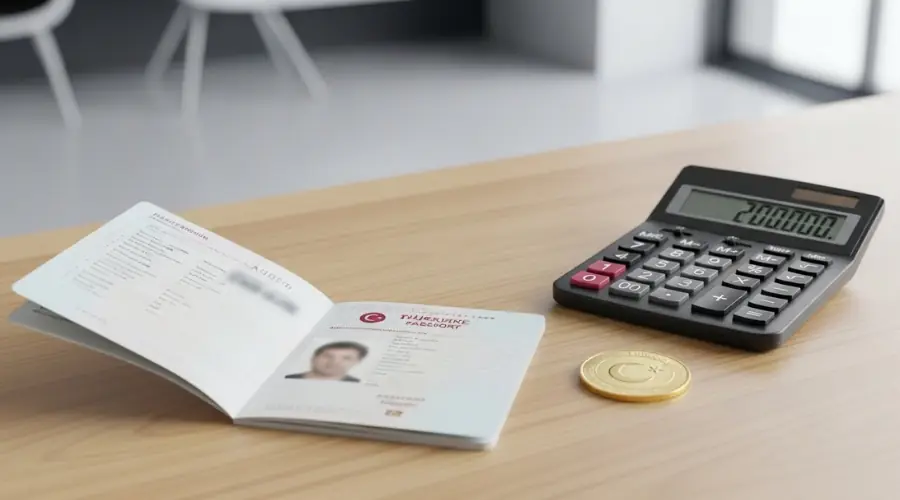
Required Documents for Real Estate Residency
- Passport: Original and color copy (must be valid for at least 6 months).
- Title Deed (Tapu): Original and copy.
- Appraisal Report (Ekspertiz): Must be recently dated.
- Health Insurance: Valid for individuals under 65.
- Residence Tax Receipt: Paid after online registration.
- Address Registry Document (Nüfus): Obtained from the Civil Registry Office or E-Devlet system.
- Criminal Record: In some cases, the Migration Office requests it.
- Translation of Marriage Certificate and Children's Birth Certificates: With Consulate or Apostille approval to prove family relationships.
Hidden Costs of Buying Property in Turkey
Buying property is not just paying $200,000 to the seller. You must include the following costs in your budget:
- Title Deed Transfer Tax (Tapu Harcı): Equivalent to 4% of the property value. By law, 2% should be paid by the buyer and 2% by the seller, but in Turkish market custom, the buyer usually pays the entire 4%.
- Value Added Tax (KDV): Varies between 1% to 20% for newly built properties. (Note: In some conditions, foreigners buying property for the first time and bringing money from abroad can get a VAT exemption).
- Appraisal Fee (Ekspertiz): About 8,000 to 15,000 Lira.
- Official Translator and Notary Fees: About 5,000 to 10,000 Lira.
- Real Estate Commission: By law, 2% is received from the buyer and 2% from the seller.
Family Residency Through Property Purchase
One of the major benefits of buying property is covering family members.
- The title deed holder receives "Taşınmaz" (real estate type) residency.
- Spouse and children under 18 can receive family residency as dependents.
- Children over 18, even if living with parents, do not get residency through the parent's deed and must pursue a separate path, such as student residency.
Comparison Table: Types of Turkish Residency (2025 Update)
| Feature | Tourist Residency (Rental) | Residency by Investment ($200k) | Citizenship & Passport ($400k) |
|---|---|---|---|
| Renewability | Very difficult / Impossible in many cities | Guaranteed (as long as you own the property) | Permanent (No renewal needed) |
| Work Permit | No | Needs separate permission | Yes (Without restriction) |
| Voting Rights | No | No | Yes |
| Minimum Amount | Only rental cost | 200,000 USD (Stated on Deed) | 400,000 USD (Stated on Deed) |
| Presence Requirement | None | None (But for citizenship after 5 years, extensive absence is not allowed) | None |
| Fate of Property | - | Can be sold (but residency will be cancelled) | Sale prohibited for 3 years |
Frequently Asked Questions (FAQ)
1. Can I buy a property in installments and get residency?
No. Until the full amount is paid and the Title Deed (Tapu) is issued in your name, you cannot apply for residency. In installment projects, the deed is usually transferred at the end of the installments.
2. Are Home Office apartments accepted for residency?
Yes, provided that the deed states its usage is residential (Mesken) or it has a residential permit. However, strictly commercial properties (Dükkan) are not accepted.
3. If the Lira value drops, what happens to my $200,000?
The Migration Office's criterion is the dollar value of the property on the day of the deed transfer. If you buy the property today and pay the Lira equivalent of $200,000, future depreciation of the Lira will not affect your residency.
4. Can I get residency by buying multiple properties totaling $200,000?
Yes, this is possible, but all properties must be residential, and your file will be reviewed cumulatively. However, it is suggested to purchase a single property valued above $200,000 to simplify the process.