



In 2026, Turkey's immigration laws have undergone fundamental changes, and merely having university acceptance does not guarantee your stay in Turkey. If you are seeking Turkish student residency, this article is your precise roadmap. Here, we review all stages, from obtaining a student visa and navigating the challenges of "Denklik" (Equivalence) and TÖMER, to the final receipt of the Kimlik card.
What is Turkish Student Residency and how does it differ from a Student Visa?
Many people assume that a "Student Visa" is the same as "Student Residency," whereas they are completely different. This section is vital for understanding your legal status in Turkey.
- Student Visa: A permit issued by the Turkish consulate in your home country allowing you to legally enter Turkey. This visa usually has limited validity (e.g., 90 days) and does not, by itself, permit long-term residence.
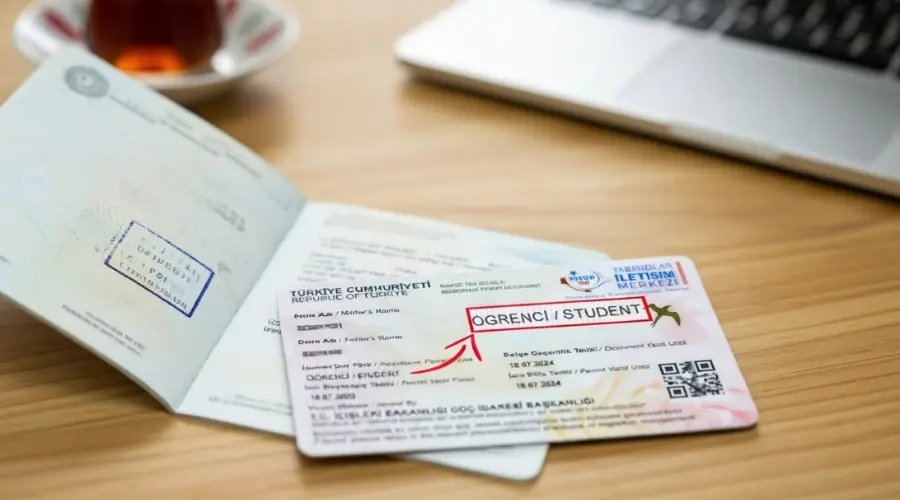
- Student Residence Permit (Öğrenci İkamet İzni): A permit issued by the "Presidency of Migration Management" (Göç İdaresi) within Turkey. This document, provided as a pink card (Kimlik), allows you to live legally in Turkey until the end of your studies, exit and enter borders, and benefit from civic services.
Important Note: Under the new 2026 regulations, entering with a tourist visa and attempting to convert it to student residency carries significant risks. Immigration officers view files entered with a student visa much more positively.
Benefits of Studying in Turkey and Obtaining Student Residency
Obtaining Turkish student residency is not just a permit to stay, but a gateway to civic privileges:
- Visa-free Entry and Exit: As long as your card is valid, you can travel to your home country and return as many times as you wish without needing a new visa.
- Museum Card (Müzekart): For a very small fee (almost free), you can visit most museums and historical sites in Turkey.
- Transportation Discounts: The Istanbulkart or metro cards in other cities offer significant discounts (sometimes up to 50%) for students.
- State Health Insurance (SGK): International students can be covered by Social Security Insurance for a reasonable fee, which drastically reduces medical costs.
- Smoother Path to Work Permits: Under new laws, students, especially at Master's and PhD levels, have an easier path to obtaining legal work permits.
Step-by-Step Process for Obtaining Turkish Student Residency (A to Z)
According to 2026 reports, the integrated Turkish migration system (GÖÇ-NET) is connected to university systems, so following the order of steps is vital:
- Obtain Final Acceptance Letter: First, you must get accepted into a public or private university.
- Get a Student Visa: Visit the Turkish embassy/consulate with your acceptance letter to obtain a student visa. (Entering without a visa may subject you to heavy "Single Entry" fines).
- Enter Turkey and Register at University: Upon arrival, visit the university to finalize your registration and receive your "Student Certificate" (Öğrenci Belgesi).
- Initial Steps: Get a SIM card in your own name, rent a house or dormitory, and obtain a Tax ID number.
- Register on E-İkamet System: You must log in to the official migration administration website, fill out the application form, and book an interview appointment (Randevu).
- Prepare Specialized Documents: Includes insurance, numbering (Numarataj), and payment of tax fees.
- Attend the Interview (Rendezvous): Go to the migration office on the scheduled date and time with your complete file.
- Wait for and Receive Card: After approval, the residence card will be sent to your address via PTT post.
Required Documents for Student Residency (Complete 2026 List)
Nowadays, strictness regarding documents, especially proof of address, has reached its peak. Check the list below carefully:
- Printed Appointment Form: Signed by the student.
- Passport and Photocopy: First page, visa page, and last entry stamp. (Passport must be valid for at least 60 days beyond the requested residency period).
- 4 Biometric Photos: White background, full face, taken within the last 6 months.
- Student Certificate (Öğrenci Belgesi): New, with a stamp or barcode.
- Valid Health Insurance (Sigorta): Private or state insurance covering the entire duration of the stay.
- UETS Code: According to the new law, an electronic notification address document that must be obtained from the post office (PTT).
- Proof of Address (Very Important):
- If renting a house: Notarized rental contract + Numbering document (Numarataj - a document from the municipality confirming the house is residential).
- If in a dormitory: Official letter from dormitory management with stamp and signature.
- Payment Receipts: Receipts from the Tax Office (Vergi Dairesi) for the residence fee and card fee.
Specific Documents for Registration at Different Levels and Denklik
To finalize your university registration and obtain a student certificate, you need previous educational documents which must be "equated" or undergo Denklik:
- Associate and Bachelor's Degrees: You need High School Diploma Denklik. This is done via the e-Denklik system and visiting centers affiliated with the Ministry of National Education (MEB). A vital point is that your documents must have an Apostille stamp or approval from the Turkish Consulate in your home country.
- Master's and PhD: You need University Degree Denklik (Bachelor's or Master's) done by the Council of Higher Education (YÖK). Sometimes, for specific fields like medicine or engineering, an STS exam is required.
Warning: The e-Denklik system is extremely sensitive to spelling discrepancies between your name in the passport and the translation of documents; even the smallest difference will cause rejection.

Cost of Student Residency in Turkey in 2026
Government fees in Turkey increase annually based on the inflation rate and the "Revaluation Rate." The table below is an estimate of the costs you must pay:
| Type of Cost | Approximate Amount (Turkish Lira) | Description |
|---|---|---|
| Card Issuance Fee | Approx. 964 TRY | Cost of the plastic card itself (Fixed for everyone) |
| Residence Fee | Variable | Citizens of certain countries are exempt from this fee based on reciprocity. |
| Single Entry Visa Fee | Approx. 10,000 TRY | Very important note: If you enter without a student visa, you may be forced to pay this heavy fine. |
| Student Health Insurance | 1,800 to 3,800 TRY | Varies depending on age and type of insurance (Private or State). |
| Translation and Notary | 2,000 to 4,000 TRY | Cost for translating passport, diploma, and notarizing the rental contract. |
| Numarataj Fee | 0 to 500 TRY | Differs depending on the municipality of the residential area. |
Age Limits for Turkish Student Residency; Are There Restrictions?
Generally, Turkish universities do not have a legal Age Limit for accepting students. You can apply for a Bachelor's degree even at age 40. However:
- For Scholarships: Government scholarships (Turkiye Burslari) have strict age limits (e.g., under 21 for Bachelor's).
- For Residency and Visa: If your age is disproportionate to the level of study (e.g., 35 years old for a Bachelor's degree), the risk of visa or residency rejection under "Article 32" (doubt regarding the true purpose of stay) increases. In such cases, you must have a strong Statement of Purpose (SOP).
New Rules for Student Work Permits in Turkey
One of the most attractive changes in recent years is the International Labor Force Law No. 6735, which has clarified work conditions:
- Master's and PhD Students: Can apply for a Work Permit (Çalışma İzni) immediately after receiving their residence card. This means you can work legally and get insured.
- Associate and Bachelor's Students: Do not have the right to work in the first year of study. However, from the second year onwards, they can obtain a work permit for part-time work (maximum 24 hours per week).
Note: The student cannot apply for a work permit personally; the employer must apply on their behalf through the Ministry of Labor system.
TÖMER (Language Schools) and Residency Strategies
The word TÖMER refers to Turkish language learning centers, but the type of center you choose affects your residency fate:
- University TÖMER: If you are accepted by a university and the university requires you to complete a language course, your residency will be of the "Student" type, and you will benefit from all student privileges.
- Private TÖMER: If you personally register at a private language institute, your residency is "Short-term for the purpose of learning a language."
- Limitation: This residency is valid for a maximum of one year.
- Warning: According to 2026 reports, obtaining residency by registering in private TÖMERs has become very difficult and certainly requires a language course visa. Also, your attendance is strictly monitored, and in case of absence, the residency will be cancelled.
Common Mistakes That Lead to Rejection of Student Residency Applications
To avoid falling into the trap of rejection, avoid these mistakes:
- Renting in Prohibited Zones: In some neighborhoods, such as parts of Esenyurt or Fatih in Istanbul where the density of foreigners is high, new residency is not issued. Be sure to check the list of "Closed Neighborhoods" (Kapalı Mahalleler) before renting a home.
- Insurance Defects: Buying very cheap and fake insurance policies that are not active in the online system.
- Entering Without a Visa: As mentioned, failure to obtain a student visa can make your file look suspicious.
- Fake Addresses: Providing addresses of friends or unreal addresses. The Numarataj and Address Registration system is designed precisely to prevent this.
Renewing Student Residency; When Should We Act?
The best time to apply for residency renewal is 60 days before the expiration of your current card.
- If you wait until the last day of card validity and the E-İkamet site does not give an appointment due to congestion, you will face an "Overstay" problem.
- For renewal, you must again provide a new Student Certificate (Aktif Öğrenci). If you are "Passive" due to low grades or failure to select courses, residency will not be renewed.
Student Residency FAQ
1. Can I bring my spouse and children to Turkey with student residency?
Yes. You can apply for residency as a "Sponsor" for your spouse and children under 18. However, you must prove sufficient financial means to cover their living expenses.
2. How long does it take to issue the residence card?
Usually, the card is mailed to your address between 30 to 90 days after the interview (Randevu). In large cities like Istanbul, this time may be longer.
3. Can I get student residency without a language certificate?
Yes. If the university gives you conditional acceptance, you can enter Turkey, attend a TÖMER course, and obtain residency based on that.
4. What is the UETS code and why do I need it?
This is the National Electronic Notification System of Turkey. Under the new law, all foreign nationals must obtain this electronic address from the central post office (PTT) to receive government letters digitally.
5. How long does Denklik take?
High school diploma Denklik (MEB) is faster if you apply through the Turkish embassy/consulate in your home country, but inside Turkey, it may take several weeks to get an appointment due to high demand.