



Acquiring Turkish citizenship is a significant and multifaceted decision that goes beyond simple residency, granting the individual a full set of legal and civil rights. While temporary residency, such as tourist residency, is always accompanied by the anxiety of renewal and uncertainty, citizenship is considered a permanent status.
The main advantages of this choice include complete life stability, freedom from visa renewal bureaucracy, and access to international economic opportunities. Turkish passport holders can travel visa-free to over 110 countries (up to 125 according to some sources), including major destinations like Japan, Singapore, and Hong Kong. Furthermore, due to bilateral treaties, Turkish citizenship provides the unique opportunity to apply for the USA E-2 Investor Visa.
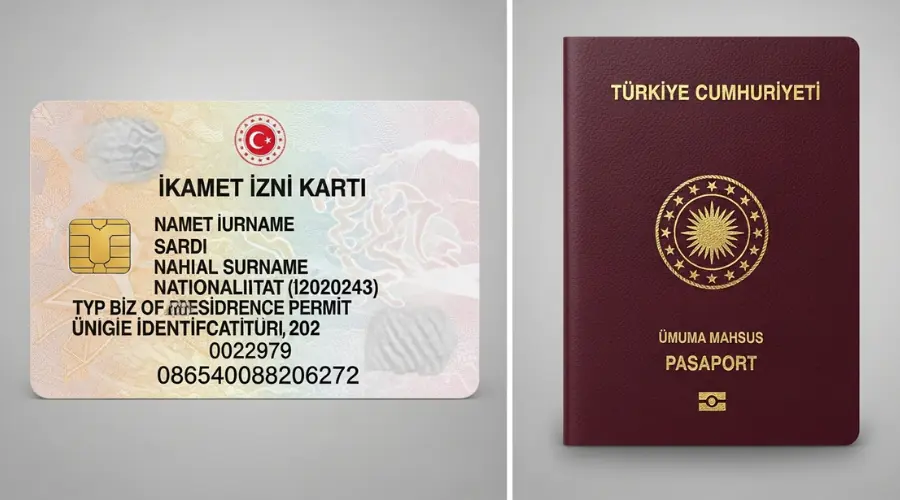
Key Differences Between "Residency" and "Citizenship" in Turkey
The biggest ambiguity for many applicants is the difference between "Residency" and "Citizenship." Understanding this distinction is vital for any financial or legal decision-making:
- Residency (Ikamet): A temporary permit to live in Turkey (such as a tourist or work residence permit). This permit must be renewed periodically and offers limited rights. You are still considered a foreign national.
- Citizenship (Vatandaşlık): Means becoming a full citizen of Turkey. This status is permanent, leads to obtaining a Turkish passport, and includes all civil rights, such as the right to vote and access to government services.
Four Main Routes to Turkish Citizenship
There are various paths to obtaining Turkish citizenship, each with different requirements and timelines. Choosing the right path depends on your goals, budget, and personal circumstances.
1. Citizenship by Investment (CBI)
- Minimum Time Required: 3 to 9 months
- Key Requirement: Investment of at least $400,000 in real estate
- Complexity Level / Main Challenge: Financial - Requires significant upfront capital
2. Citizenship by Marriage
- Minimum Time Required: At least 3 years
- Key Requirement: 3 years of genuine marriage and proof of cohabitation
- Complexity Level / Main Challenge: Verification - Detailed interviews and police investigations
3. Citizenship by 5-Year Residency
- Minimum Time Required: At least 5 years
- Key Requirement: 5 years of continuous legal residency
- Complexity Level / Main Challenge: Time-consuming - Proving continuity of residence and income
4. Citizenship by Descent (Birth)
- Minimum Time Required: Variable, depends on documentation
- Key Requirement: Proof that at least one parent was Turkish
- Complexity Level / Main Challenge: Evidentiary - Requires official genealogy documents
Obtaining Turkish Citizenship via Investment (CBI)
The most popular and fastest route to obtaining Turkish citizenship is the "Citizenship by Investment" (CBI) program. This program allows foreign investors to apply directly for citizenship in exchange for a significant financial contribution to the Turkish economy.

Real Estate Investment (Most Popular Option)
Due to its relative simplicity, this is the most common choice in the CBI program.
- Principal Amount: The minimum investment amount is $400,000 (Four Hundred Thousand US Dollars) or its equivalent in foreign currency.
- Main Requirement: The investor must legally commit not to sell the purchased property (or properties) for at least 3 years. This commitment must be explicitly recorded in the property's title deed (known as Tapu in Turkey).
While the official amount is $400,000, other figures (such as $450,000 or the old amount of $250,000) may sometimes be mentioned in unofficial sources. However, according to official government sources like the Investment Office of the Presidency of Turkey, the current threshold for real estate is $400,000.
Other Investment Options ($500,000)
For applicants who do not wish to engage in property purchase and management, alternative options with a $500,000 threshold exist:
- Bank Deposit: Depositing at least $500,000 USD (or equivalent) in a Turkish bank and committing not to withdraw it for 3 years.
- Government Bonds or Funds: Purchasing government bonds, Real Estate Investment Fund (REIF) shares, or Venture Capital (VC) fund shares worth at least $500,000 and holding them for 3 years.
- Job Creation: Establishing a business and creating jobs for at least 50 Turkish citizens.
Important Warnings: Investment Rules and Pitfalls
Citizenship by investment is a highly sensitive financial and legal matter. The Turkish government has established strict rules to prevent abuse and ensure genuine foreign currency inflow. Ignoring these rules can lead to a definitive rejection of the application.
1. Real Estate Purchasing Pitfalls:
These rules are designed to prevent actions where properties are artificially exchanged between individuals solely to meet the $400k threshold without new currency entering Turkey.
- Prohibition on Buying from Foreigners: The property you buy must not be owned by another foreign individual (except in specific inheritance cases).
- Prohibition on Property Reuse: A property that has previously been used for a citizenship application cannot be used again for another citizenship application.
- Prohibition on Buying from Related Companies: The property must not be purchased from a legal entity (company) where the owner or manager is the applicant themselves, their spouse, their children, or a company of the same nationality as the applicant.
- Eligible Property Types: Purchasing vacant land (Arsa) or fields (Tarla) with no structures is usually not eligible. The property must have "Condominium Ownership" (Kat Mülkiyeti) or "Floor Easement" (Kat İrtifakı - meaning a valid under-construction project) status.
- Official Valuation: The property value is assessed based on the purchase price or the Official Valuation Report (whichever is lower). Therefore, one cannot buy a cheap property and artificially inflate its price on paper.
2. Money Transfer Requirements:
- The entire investment amount must be transferred to Turkey legally through the banking system. Cash transfers or transfers via informal exchange offices are not acceptable.
- The applicant must obtain a "Foreign Exchange Purchase Certificate" (Döviz Alım Belgesi) from the bank, proving that the foreign currency was sold to the bank and converted into Lira.
Key Changes to Citizenship by Investment (2025)
Immigration laws are not static. Two very important changes in 2024-2025 have affected the CBI process, indicating stricter procedures:
1. Currency Risk Warning: End of KKM Program for New Investors
- Previously, the $500,000 bank deposit option was attractive due to the Currency Protected Deposit (KKM) scheme. This scheme protected Lira deposits against severe exchange rate fluctuations and devaluation against the dollar.
- Key Change: According to reports, as of 2025, this protection program is not available for new CBI investors.
- Implication: This means if an applicant chooses the bank deposit option (which often requires converting dollars to Lira), they must now accept the full risk of currency fluctuations and potential capital erosion due to inflation or Lira devaluation for 3 years. This change has significantly increased the financial risk of this option.
2. Stricter Requirements for Spouses
Recent changes indicate that the government is scrutinizing not just the main investor, but the entire family more closely:
- Criminal Record Requirement: Previously, providing a clean criminal record was mainly mandatory for the main applicant. Now, the applicant's spouse is also required to provide a valid (translated and apostilled) criminal record certificate.
- Physical Presence Requirement: Previously, many steps could be done remotely. Now, both the main applicant and their spouse must be physically present in Turkey to provide fingerprints for the Residence Permit (Ikamet), which is a prerequisite for the citizenship application. This requires logistical travel planning for both individuals.
Alternative Routes to Turkish Citizenship:
Although the investment route is the fastest, it is not the only way. Turkish law recognizes other paths based on family ties, birth, and long-term residency.
Citizenship via Marriage:
This route is based on a genuine marriage to a Turkish citizen, but contrary to popular belief, citizenship is not granted automatically.
Main Conditions:
- Duration: The applicant must have been legally married to a Turkish citizen for at least 3 years.
- Genuine Cohabitation: The marriage must not be fake or merely on paper. The applicant and the Turkish spouse must prove they are living together "within the framework of family unity."
- Good Faith and Security: The applicant must not engage in activities incompatible with the marriage union (such as serious misconduct) and must not pose a threat to Turkey's national security or public order.
Verification Process:
The Turkish government has a rigorous verification process to distinguish fake marriages from real ones. This path requires patience and honesty.
- Police Investigation: After filing the application, the file is referred to the police for security checks.
- Commission Interview: The applicant and the Turkish spouse are invited to an interview before a special commission. In this interview, questions are asked both jointly and separately to assess the accuracy of information and the genuineness of the relationship.
- Field Investigation: In some cases, officials may conduct unannounced visits to the residence or interview neighbors to verify cohabitation.
Legal Notes:
- If the Turkish spouse passes away after the citizenship application is filed, the application can still proceed.
- If the marriage ends in divorce after citizenship is granted, the foreign individual's citizenship is retained if it is proven that the marriage was entered into with "good faith" from the beginning.
Citizenship via Long-Term Residency
This path, known as "Naturalization," is for individuals who have chosen Turkey as their permanent home.
Main Conditions:
- Continuous legal residency in Turkey for 5 consecutive years prior to the application date.
- Proof of sufficient financial means to support oneself and one's family in Turkey.
- No serious criminal record and no threat to national security.
- Freedom from any contagious disease threatening public health.
- Demonstrating adaptation to life in Turkey, which usually includes having basic knowledge of the Turkish language sufficient for daily needs (this is often assessed during the interview).
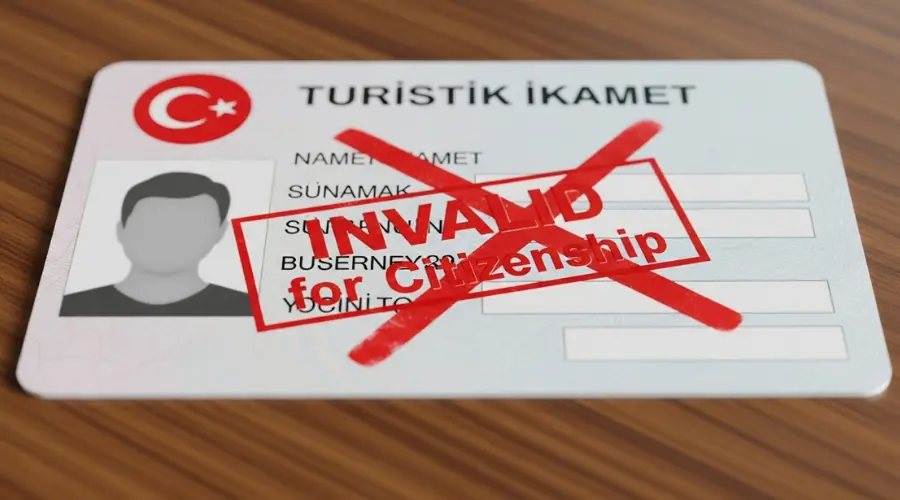
The Tourist Residency Trap:
Many foreigners waste years of time and financial resources under the false belief that simply living in Turkey with any type of residency leads to citizenship. Short-term tourist residence permits (Turistik İkamet İzni), even if renewed for consecutive years, absolutely do not count towards the 5 years of residency required for citizenship.
This is a common trap that can lead to disappointment. The Turkish government has explicitly stated that the purpose of tourist residency is tourism, not permanent settlement.
Which Residencies Count for the 5 Years?
For your 5 years of residency to be eligible, it must be via other valid permits, such as:
- Work Permit (Çalışma İzni): Residency via legal employment for a Turkish employer.
- Residency via Property Ownership: Even if you buy a property valued below the $400,000 citizenship threshold (e.g., a property used only for annual residence), this type of residency is usually included in the 5-year calculation.
- Student Residency: The duration of student residency is typically calculated at half value (e.g., 4 years of study counts as 2 years).
Citizenship by Descent (Birth):
Turkish citizenship law is primarily based on "Jus Sanguinis" (Right of Blood), not "Jus Soli" (Right of Soil). What does this mean? If at least one of your parents (mother or father) was a Turkish citizen at the time of your birth, you are considered a Turkish citizen from birth. This rule applies regardless of which country (inside or outside Turkey) you were born in.
However, simply being born on Turkish soil (while both parents are foreigners) does not automatically grant Turkish citizenship to the child (The only exception is if the child is at risk of becoming stateless). Applicants for this route must prove this blood tie by providing official documents such as birth certificates, identity documents of the Turkish parent, and population registry records.

Steps to Get Turkish Citizenship (Step-by-Step)
Although details vary depending on the chosen route, the general process is as follows:
-
Fulfill Prerequisites: First, you must meet the core requirement of your route (e.g., buying property and obtaining a "Certificate of Conformity"; or completing 3 years of genuine marriage; or completing 5 years of legal residency).
- Obtain Residence Permit (Ikamet): You must hold a valid residence permit in Turkey at the time of the citizenship application. For investors, this is usually a special short-term residency based on investment. (As noted, this is now also mandatory for investor spouses).
- Document Preparation: All required documents must be collected, officially translated into Turkish, notarized, and if necessary (for foreign documents), Apostilled.
- Official Application: The complete file is submitted to the Directorate of Population and Citizenship Affairs (Nüfus ve Vatandaşlık İşleri) in the province where you reside.
- Preliminary Review and Fingerprinting: Physical presence is mandatory at this stage to provide fingerprints. Preliminary interviews (especially for marriage and 5-year residency routes) are also conducted.
- Security Clearance (Waiting Stage): This is the longest phase. Your file is sent to relevant authorities in Ankara for detailed security checks.
- Final Decision: Once checks are complete, the application is approved or rejected by high authorities (ultimately the Presidency), and the decision is published in the Official Gazette.
- Receiving Documents: Upon approval, you will proceed to receive your Turkish National ID Card (Kimlik Kartı) and then apply for a Turkish passport.
Does Turkey Accept Dual Citizenship?
Yes. One of the main concerns for applicants is the need to renounce their current citizenship. Fortunately, Turkish law recognizes dual citizenship. This means that applicants can retain their previous passports and citizenship while obtaining Turkish citizenship.
Conclusion
Obtaining Turkish citizenship is generally a complex process requiring high attention to detail. While choosing the investment route as the fastest option may seem attractive initially, it must be accompanied by high legal and financial diligence to avoid legal pitfalls. Also, marriage and long-term residency routes require patience, time, and serious proof of integration into Turkish society. Since immigration and investment laws in Turkey are constantly changing, the right decision should be made based on individual circumstances and consultation with legal and financial experts. We suggest consulting with our experienced experts at Zarsan Global to ensure this path is navigated correctly.