



Introduction: The Necessity of Connecting to the Global Financial Network
In recent years, extensive changes in financial geopolitics and international pressures on monetary systems have doubled the importance of having a valid bank account across borders. Due to its strategic location and the link between European and Asian banking systems, Turkey has become the primary financial haven for non-residents, freelancers, traders, and investors. For anyone living outside Turkey's borders, this account means free access to Visa, Mastercard, and the SWIFT network, effectively neutralizing local banking limitations in their home countries and making connection to the global economy possible.
Section One: Regulatory Framework and the Role of the BDDK
The Turkish banking system operates under the direct supervision of the Banking Regulation and Supervision Agency (BDDK). In the 2025-2026 period, this organization has intensified its oversight to fully align with international standards and exit specific monitoring lists. This has caused the "Compliance" process for foreign nationals, especially those from high-risk countries or those under special monitoring, to be conducted with double scrutiny.
Banks are obliged to inspect the applicant's documents via central units before final account activation. This inspection includes verifying the source of funds and ensuring non-involvement in money laundering activities. For this reason, banks' treatment of non-residents is less about a fixed law and more dependent on the internal policies of each branch, the applicant's nationality, and the risk appetite of that branch's management.
Section Two: The Substantive Difference Between Resident and Non-Resident Accounts
Many applicants assume that access to banking services is impossible without a residence permit card. In the Turkish banking system, two statuses are defined: Resident and Non-resident. Residents, with an ID number issued by the migration office, enjoy full banking rights.
For non-residents, opening an account is done based on a Potential Tax Identification Number and a valid passport. These accounts have capabilities such as online shopping, SWIFT transfers, and use of the banking app, but they usually face daily transaction limits, and obtaining loans without property collateral is not possible for them.
Section Three: Operational Prerequisites and Mandatory Documents
Tax Number (Vergi Numarası)
The ten-digit tax number is the first and most vital step. Without this code, no bank is allowed to open a file. This code can be obtained by visiting the tax office in person or online. Having a printed copy of it when visiting the bank is essential.
Proof of Address
Under international laws, banks are required to register a valid address. The best document for non-residents is an official translation of a utility bill from their home country in the applicant's name, approved by a Turkish notary public. In some state branches, a temporary residence address in Turkey is also accepted, but an official bill from the home country is the most reliable option.
Active Turkish SIM Card
A local SIM card is the primary tool for account security. All one-time passwords (OTPs) and confirmation messages are sent through it. Tourist SIM cards have a limited lifespan, and failure to renew them can disrupt your access to the account.
.webp)
Section Four: Analysis of Main Banks' Performance Regarding Non-Residents
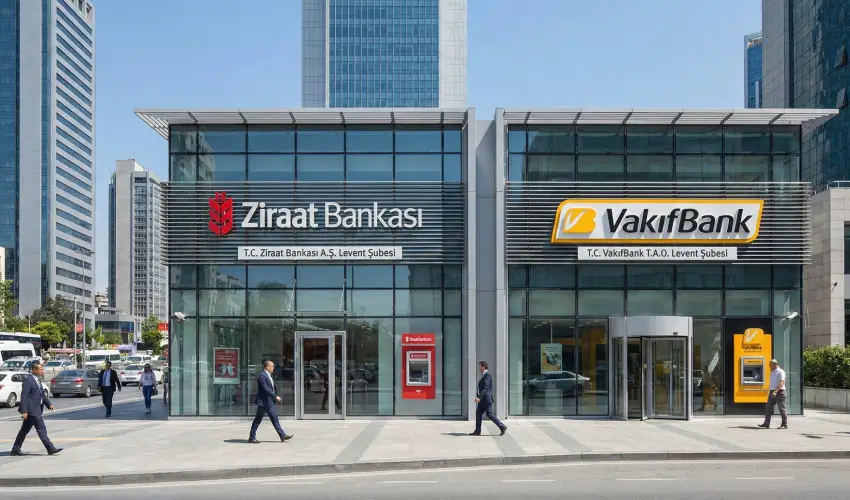
Ziraat Bank (Ziraat Bankası)
Ziraat Bank is the most flexible option for foreign nationals. This bank allows for opening multi-currency accounts and receiving a physical card immediately. In some branches, a blocked deposit of between 10,000 to 30,000 Lira is requested for a short period.
VakıfBank
VakıfBank is very powerful in foreign exchange services. Its key advantage is the issuance of a credit card backed by a blocked deposit, which is highly useful for hotel reservations, car rentals, and international payments.
Private Banks and Neo-banks
Private banks like İş Bank and Garanti have become stricter in 2026 and usually do not open accounts without a work or student residency permit unless there are substantial deposits. Neo-banks like Ozan and Papara are suitable for small payments but are not recommended for holding large amounts of capital.
Section Five: Profit and Investment Mechanisms 2025-2026
Lira Deposit Interest
Interest rates on Lira deposits remain high, but inflation must also be considered. Interest is deposited into the account monthly after tax deduction.
Foreign Currency Accounts
Interest on Dollar and Euro accounts is low. The main purpose of these accounts is the security of holding currency and the ease of international transfers.
Participation Banking
Banks like Kuveyt Türk are suitable options for Islamic banking. In this model, profit is calculated based on participation in projects, and they usually have lower operational fees.
Section Six: Account Security and Remote Risk Management
IP Risk
Logging into mobile banking with an IP from high-risk countries can lead to immediate account blocking. Using a Static IP or a dedicated Virtual Private Server (VPS) is the safest way to manage the account remotely.
Roaming and SMS
Keeping the SIM card's roaming active is essential. To prevent service disconnection, the SIM card must be topped up periodically.
Suspicious Transactions
Using a personal account to move unidentified funds or dealing with unofficial exchanges drastically increases the risk of blocking by MASAK (Financial Crimes Investigation Board), and resolving it requires physical presence in Turkey.

Section Seven: Common Scams and Security Warnings
In 2026, opening an account without physical presence is not possible. There is no such thing as a "branch fee," and any payment must be deposited directly into your personal account. Accepting a ready-made account or card carries serious legal and criminal risks.
Conclusion and Strategy for Success
Opening a bank account in Turkey for non-residents is an entry into the free global economy. With complete documents, visiting state branches in the early hours of the day, and professional conduct, the chance of success reaches over 90 percent. A well-groomed appearance and proper interaction with the bank employee play a decisive role in the final approval of the compliance process.