



Introduction: New Economic Landscape and Bank Interest Rates in 2026
The year 2026 can be considered a significant turning point in modern Turkish economic history; a year where strict monetary policies implemented to curb runaway inflation have given way to a period of relative stability and a focus on sustainable growth. For foreign investors, especially international nationals monitoring the Turkish financial market, understanding these structural changes is vital. In January 2026, the Central Bank of Turkey made a strategic decision to lower the policy interest rate to 37%, sending a clear message to markets that inflation is under control. However, the investment paradigm has shifted compared to previous years, and deposit interest rates in private banks remain at attractive levels that require careful examination.
While inflation remains a key variable in the Turkish economy, its decline to levels below 30% at the beginning of the year and the target of reaching 16% by year-end have created a new space for calculating the "real interest rate." These changes mean that investors are no longer dealing only with nominal numbers but must analytically approach issues such as withholding tax (Stopaj) and currency fluctuations to make the most of the opportunities available in 2026.
1. Structural Analysis of Monetary Policies and Real Interest Rates
Monetary policies of the Central Bank of Turkey in 2026 are walking a tightrope; on one hand, they must maintain the attractiveness of the Lira to prevent the dollarization of the economy, and on the other, reduce borrowing costs to aid production. Analysts at reputable financial institutions like Goldman Sachs predict that interest rates will trend downwards by the end of 2026, reaching the 25-30% range. This forecast holds an important message for depositors: Current attractive interest rates may not be sustainable, and the strategy of locking in high rates in long-term deposits in the first half of the year seems to be a smart move.

The concept of the real interest rate has gained double importance in 2026. Unlike previous years when the inflation rate was higher than bank interest, effectively leading to a real loss for deposits, in 2026, with inflation expected to drop to around 16%, a positive gap is anticipated between bank interest (which is around 37% to 45%) and inflation. This means that if an investor opens an account at the beginning of 2026, even after deducting tax and inflation, they will likely earn a positive real return, and the purchasing power of their interest income will increase.
2. Detailed Review of Interest Rates in the Banking Network (Private vs. Public)
In the competitive market of 2026, there is a deep gap between the rates offered by large state banks and agile private banks. Private and digital banks like Odea Bank and Burgan Bank, which have lower overhead costs, are leaders in offering high interest rates. For example, the "Oxygen" account at Odea Bank, with rates sometimes rising to 52% in special campaigns, is one of the most aggressive products in the market. Also, digital accounts like "ON" at Burgan Bank or "VOV" at Alternatif Bank, with rates of 44% to 45%, are attractive options for those seeking maximum returns on their capital.
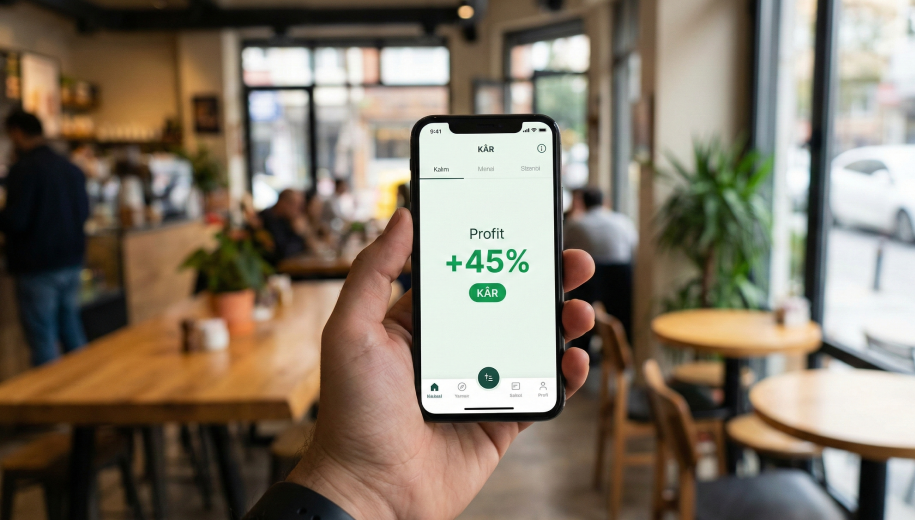
In contrast, systemic state banks like Ziraat Bank and VakıfBank have a more conservative approach. Ziraat Bank, which is usually the first option for foreign nationals to open an account, offers rates in the range of 34% to 39.5%, which is lower than its private competitors. VakıfBank has also tried to attract customers with schemes like the "Bee Account," offering a 41% rate in the first month, but these rates drop significantly after the initial period. Therefore, investors must choose between "ease of opening an account in state banks" and "higher interest in private banks."
3. New Tax Regime and Its Impact on Net Profit
One of the most important changes in 2026 is the reform of the withholding tax (Stopaj) on deposit interest, which directly affects the final earnings of customers. In line with fiscal discipline, the Turkish government has abolished past exemptions and implemented a tiered tax system. According to this law, short-term deposits (up to 6 months) are subject to 17.5% tax, while this rate decreases to 15% for medium-term deposits (6 to 12 months) and to 10% for deposits over one year. This structure clearly shows that the policymaker intends to push people towards long-term deposits.
To calculate profit accurately, the investor must know that the interest declared by banks is "gross." For example, if a person places one million Liras in a 32-day deposit at a rate of 45%, after calculating the daily interest, they must deduct 17.5% of it as tax. Ultimately, despite this tax deduction, the effective interest rate remains higher than the forecasted inflation for 2026, indicating that the money market retains its attractiveness for risk-averse investors.
4. Foreign Currency Accounts and the Special YUVAM Scheme
For international investors who hold their capital in Dollars or Euros, the Turkish banking system has two completely different paths. The first path is standard foreign currency deposits, which have negligible interest (about 1% to 2%) and effectively make no economic sense. However, the second path is the special YUVAM scheme, which the Turkish government continues to implement strongly to attract foreign capital. This scheme is one of the safest methods for foreigners because the Central Bank of Turkey guarantees the principal capital.

The YUVAM mechanism is designed so that the investor wins in any scenario. If the dollar rate jumps during the deposit period, the bank pays the exchange rate difference plus an extra currency interest (between 1% to 3% depending on the term). But if the currency market is stable and the dollar does not grow, the bank commits to paying the customer the high Lira interest (at least equivalent to the policy rate of 37%). This feature allows the investor to effectively have a full hedge against market fluctuations.
5. Operational Guide to Opening an Account for International Investors
The process of opening an account in Turkey for foreigners in 2026 is still accompanied by compliance challenges, but there are clear paths. Ziraat Bank continues to be known as the main gateway for non-resident foreigners into the Turkish banking system. The usual procedure at branches of this bank is that the customer is asked to block a certain amount (usually between 30,000 to 100,000 Liras) for a period to guarantee good faith and account turnover. Main documents include a passport, Tax ID Number (Vergi Numarası), and a Turkish SIM card.
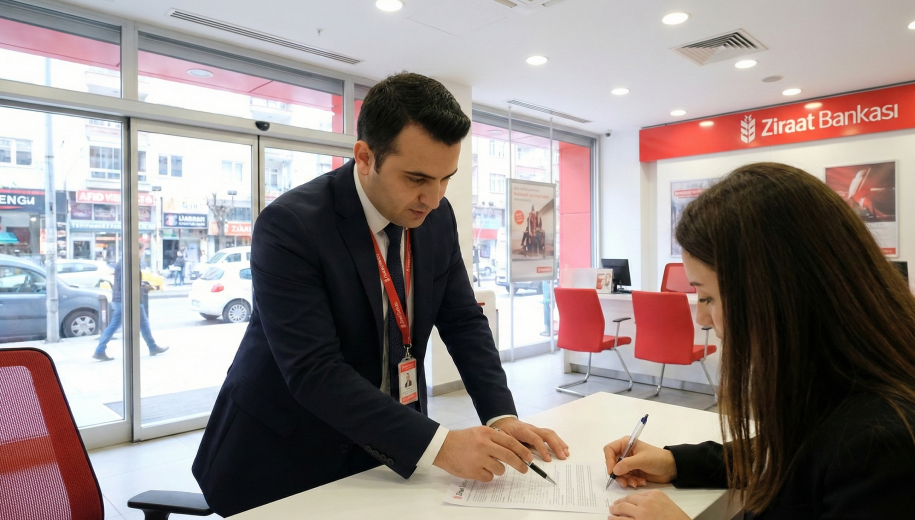
On the other hand, private banks like İş Bank or Garanti Bank offer much more advanced services, including powerful mobile apps, but opening an account there is usually conditional on having a residence permit (Kimlik). For foreigners who have Turkish residency, using private and digital banks is recommended due to higher interest and better services, but for tourists and non-resident investors, Ziraat Bank and to some extent VakıfBank remain the most accessible options.
6. Analytical Comparison: Bank vs. Real Estate vs. Stock Market
The question many investors ask is whether the bank is the best destination for capital. Compared to the real estate market, it must be said that the Turkish housing market has entered a phase of relative stagnation in 2026, and the price-to-rent ratio (P/E) in cities like Istanbul has increased significantly. This means if your goal is monthly income, bank interest offers a much better yield than property rental. However, if you have a 10-year view, real estate remains a secure option for preserving capital value.
Compared to the capital market, the Istanbul Stock Exchange (BIST 100) has an inverse correlation with interest rates. With the start of the interest rate reduction trend in 2026, the stock market is expected to become more attractive. Investment funds that are a combination of stocks and bonds have the potential for higher returns than bank deposits, but naturally, they also carry the risk of principal fluctuation. Therefore, bank deposits are more suitable for risk-averse individuals, and the stock market for risk-takers.
7. Conclusion and Suggested Ladder Strategy
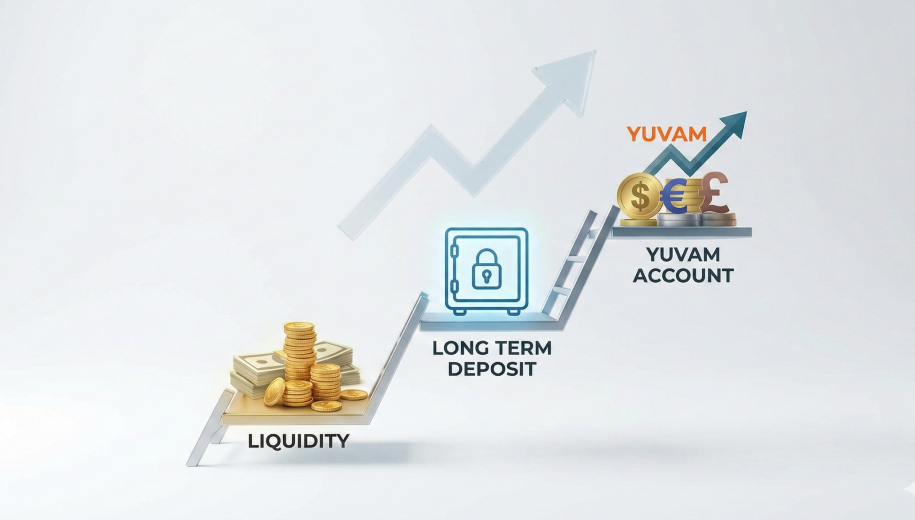
Considering all economic conditions of 2026, the best approach for investing in Turkish banks is to use the "Ladder Strategy." It is suggested that investors divide their capital rather than placing it all in one type of account. Keep a portion of the capital (e.g., 30%) in short-term 32-day accounts to maintain liquidity. Lock a larger portion (about 40%) in 6-month or one-year fixed-rate accounts before the potential interest rate cut in the second half of the year to benefit from high rates for a longer period. You can invest the remaining capital in the YUVAM scheme to cover currency risk.
In conclusion, the Turkish banking ecosystem has reached greater maturity in 2026. The era of astronomical profits caused by hyperinflation has ended, replaced by real and stable returns. Seizing the opportunity in the first half of the year to open long-term accounts and using digital banks that offer more competitive interest rates will be the key to investors' success in the coming year.