

While the previous section of this report focused on investment mechanics, economic figures, and real estate market opportunities, this section is dedicated to the soul, history, and pulse of life in this district. Beyoğlu is not merely a collection of streets and buildings; it is a living museum of coexisting cultures, the intersection of art and commerce, and the focal point of Istanbul's social evolution over time.
Spanning an area of approximately 8.76 square kilometers and encompassing 45 distinct neighborhoods, Beyoğlu has a resident population of around 225,000 to 230,000. However, it hosts millions of citizens, employees, and tourists daily who flock to this area for work, shopping, and entertainment.
Historical Evolution and Urban Morphology: From a Genoese Colony to the Paris of the East
The historical roots of Beyoğlu date back to the pre-Christian era and the Byzantine Empire. At that time, the city's center was located in the historical peninsula (the modern-day Fatih district), and the area now called Beyoğlu consisted of orchards, vineyards, and hills situated outside the ancient walls of Galata. Hence, the Greeks and Byzantines referred to this area as "Pera," which literally translates to "the other side," "the opposite shore," or beyond the gulf.
Based on historical documents, the modern name "Beyoğlu" (meaning "son of the lord") refers to the presence of aristocrats in this region. Some attribute it to the son of a Byzantine emperor, while others link it to the Venetian ambassador who resided in a magnificent mansion in this area. Although Galata had been a thriving port and a base for Genoese and Venetian merchants since ancient times, the true flourishing and physical transformation of Beyoğlu occurred in the 19th century, coinciding with the Tanzimat reforms in the Ottoman Empire.
During this period, European diplomats and merchants (Levantines) decided to leave the confined walls of Galata and build their homes and mansions along the routes that became known as the "Grande Rue de Pera" (today's Istiklal Avenue). The presence of this multinational community turned Beyoğlu into a showcase of modernization. Wooden houses were replaced by magnificent stone and brick mansions featuring Neoclassical, Art Nouveau, and Baroque architecture. Pera was the first area in Istanbul to be equipped with a central electricity network and telephone lines, and the Western lifestyle took root here with the opening of luxurious cafes, theaters, and opera houses.
Prominent Neighborhoods and Social Atmosphere
The cultural and structural diversity within Beyoğlu's 45 neighborhoods ensures that every visitor or new resident can find their ideal atmosphere.
Taksim Square and Istiklal Avenue (Taksim & Istiklal Caddesi)
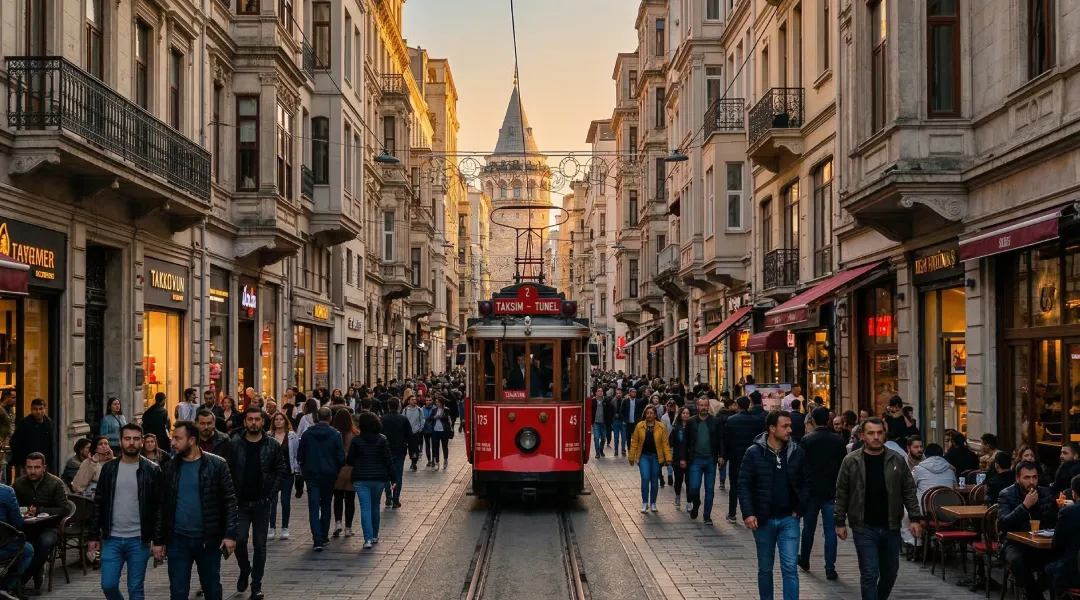
Taksim Square is the beating, modern heart of Istanbul. Serving as the center for public gatherings and national events, the square is home to the Republic Monument and the newly built Taksim Mosque. Istiklal Avenue begins right from this square; it is a cobblestone pedestrian boulevard, approximately 1.5 kilometers long, traversed by millions of people every day.
Lined on both sides with historical mansions, diplomatic missions, art galleries, and global brand boutiques, this avenue is a symbol of the coexistence of history and modern consumerism. The slow movement of the nostalgic red tram along this street has become an iconic image of Istanbul recognized worldwide.
Galata Neighborhood
With its steep streets, historical stone steps, and fashion and antique shops, Galata boasts an attractive bohemian vibe. The landmark of this neighborhood is the Galata Tower, originally built as a watchtower by the Genoese and now serving as a museum offering a 360-degree panoramic view of all of Istanbul. At night, the area surrounding the tower is filled with boutique cafes and restaurants serving traditional and international cuisines.
Karaköy Neighborhood
Stretching along the shores of the Golden Horn and the Bosphorus, Karaköy is an unparalleled example of transforming an industrial port area into a modern hub of art and entertainment. The alleys of this neighborhood, featuring murals and colorful umbrella-covered roofs, host a blend of traditional and modern businesses. Alongside old bakeries and historical baklava shops, third-wave coffee shops and modern art galleries are rapidly growing.
Cihangir and Çukurcuma (Cihangir & Çukurcuma)
Cihangir, with its tree-lined alleys, restored apartments with French windows, and cozy cafes, is a popular hangout for intellectuals, writers, actors, and the Western expat community. The unique charm of this neighborhood has made buying property in Beyoglu a top priority for those seeking to live in an authentic, artistic, and luxurious environment. This area offers a quieter atmosphere compared to the hustle and bustle of Istiklal. The adjacent neighborhood, Çukurcuma, is the beating heart of Istanbul's antique shops, and wandering through its alleys feels like a journey through time.
Nightlife and Cafe Culture
Beyoğlu is the capital of entertainment and nightlife in Istanbul. Nevizade Street and French Street are the main hubs for these activities. French Street, which has been beautifully restored, now creates an energetic atmosphere with its terraced cafes, seafood restaurants, and open-air live music performances. On the other hand, the traditional pastry and coffee-drinking culture is vividly alive in the authentic coffeehouses of this district.
Cultural, Artistic Infrastructure, and Reference Libraries
Beyoğlu is not only a center for commerce and leisure but also the focal point of intellectualism and contemporary art in Turkey. The Istanbul Museum of Modern Art, located in the new district of Karaköy, is the most prestigious contemporary art institution in Turkey, displaying a vast collection of visual arts. Furthermore, the Pera Museum, with its collection of Orientalist paintings, and the Museum of Innocence, founded by Nobel laureate Orhan Pamuk, are among other major cultural attractions in the area.
For researchers and students, Beyoğlu is a paradise of written resources. The Atatürk Library holds a special place with over 500,000 books and operates 24/7. Salt Galata, once the headquarters of the Ottoman Imperial Bank, has now been transformed into one of the most modern and beautiful research, library, and art spaces in all of Istanbul.
Public Transportation Network, Urban Connections, and Accessibility
Istanbul's geography, built on numerous hills, makes the transportation system a serious challenge. Nevertheless, city management has established a highly efficient and intertwined network of rail lines in this region, making Beyoğlu one of the most accessible parts of the city.
The historical Tünel funicular, connecting the Karaköy area to Istiklal Avenue, is the second-oldest underground urban rail line in the world, right after the London Underground. The modern Kabataş-Taksim funicular connects Kabataş station to the Taksim metro station in just 2.5 minutes. The M2 metro line and the T1 tram line also provide fast and traffic-free access to other major commercial and historical points of Istanbul.
In addition to rail infrastructure, Beyoğlu is an highly pedestrian-friendly area. Wide walking paths along the Golden Horn, Galataport, and internal streets make walking from Taksim to Karaköy a pleasant experience.
Welfare Infrastructure: Medical Care System
The historical presence of European diplomats and religious missions in Beyoğlu has given this district a special and historical standing in Turkey regarding medical standards and healthcare infrastructure. The variety of private hospitals in this area is unmatched, offering services at international standards.
The most prominent medical center in this district is the Austrian Sen Jorj Hospital, with roots dating back to 1872. Today, this non-profit hospital provides specialized services to patients from 56 different countries in 10 different languages. The historic French La Paix Hospital, along with dozens of dental clinics, pharmacies, and family health centers, provide a secure and integrated network for both local residents and expats.
| Medical Center Name | Specialty and Services | Historical Background / Notes |
|---|---|---|
| Austrian Sen Jorj Hospital | Specialized General Hospital, Multilingual Services | Established in 1872, roots in 1930s international cooperation |
| French La Paix Hospital | Psychiatry Specialty | Established in 1858, one of the oldest modern Ottoman medical centers |
| Piyalepaşa Clinics and Health Centers | Dentistry, Pharmacy, General Health | Excellent distribution to meet the daily needs of residents |
Educational and Academic Landscape: Network of International Schools
For expats, diplomats, and international professionals choosing to live in Beyoğlu, access to a multilingual educational system compatible with global standards is an undeniable priority. Istanbul, specifically European districts like Beyoğlu, houses a strong network of international schools where English, German, French, Italian, and Arabic are taught.
The British International School in Istanbul (BISI), offering the British National Curriculum and the IB Diploma program, prepares students to enter the world's top universities. Other well-established schools include the Italian High School, the German High School of Istanbul, and historical French-rooted high schools like Saint Benoît, all of which have maintained their rigorous academic and disciplinary standards.
Social Ecosystem, Coexistence, and Traditions
Life in Beyoğlu goes beyond museums, schools, and restaurants; it has a unique social fabric. One of the most charming aspects of daily life in this area is the strong presence of street cats. These animals, which enjoy the full and affectionate support of the community, have become an integral part of the city's identity.
Moreover, the coexistence of religious traditions with modern urban life is clearly evident here. During the holy month of Ramadan, while cafes and restaurants are filled with foreign tourists during the day, at dawn, the sound of traditional drummers echoes through the cobblestone streets to wake people for Suhoor, creating a unique cultural experience for international residents.
Analytical Conclusion
The Beyoğlu district in Istanbul is not merely a geographical boundary; it is an ecosystem where the rapid flow of capital is intertwined with deep history and culture. From an urban living perspective, Beyoğlu is the unrivaled hub of culture, art, diplomacy, and education in Turkey.
The presence of top-tier museums, rich 24-hour libraries, an efficient transport network, international hospitals, and prestigious bilingual schools in this district provides a standard of living for professionals, families, and expats that is very difficult to find anywhere else in the Middle East and Eurasia. Entering this district and opting to invest here (as one of the most strategic destinations for buying property in Istanbul) will be a smart decision based on sustainable values.